Introduction: The Digital Atelier and the Virtualization of Apparel Customization
The internet has dissolved the geographic constraints that once governed the production of custom apparel. No longer must one seek out a local screen printer or navigate the vagaries of a neighborhood embroidery shop. The digital realm now offers a panoply of platforms where hoodies may be designed, proofed, and ordered with the click of a button. The virtual atelier is open for business, twenty-four hours a day, accessible from any device with a network connection. This treatise examines the modalities, platforms, and considerations incumbent upon the online customizer.
The Ontology of Online Customization: A Taxonomy of Models
The Design-Your-Own Interface: A Simulation of Agency
The design-your-own interface is the most visible manifestation of online customization. It presents the user with a virtual garment—a hoodie rendered in two or three dimensions—onto which graphics, text, and colors may be applied. The interface simulates the experience of a design studio, offering palettes, fonts, and clipart libraries. The agency it confers is real but circumscribed. The user manipulates virtual elements, but the underlying production remains a standardized industrial process.
The Upload-and-Order Paradigm
A simpler model is the upload-and-order paradigm. The user prepares their artwork externally—in Adobe Illustrator, Canva, or another design application—and uploads the finished file to the platform. The platform then applies the design to the selected garment without further manipulation. This model assumes a degree of design proficiency on the part of the user. It offers greater creative control but less hand-holding.
The Assisted Design Model: Human Mediation in a Digital Realm
Between these poles lies the assisted design model. The user submits a concept, a sketch, or a rough file, and a human designer employed by the platform refines it into a production-ready graphic. This model combines the convenience of online ordering with the expertise of a professional designer. It is particularly suited to businesses that lack in-house design capabilities.
Platform Archetypes: A Survey of the Online Ecosystem
Print-on-Demand Aggregators: The Democratization of Merchandise
Print-on-demand platforms such as Printful, Printify, and Redbubble have democratized the production of custom merchandise. These platforms integrate with e-commerce storefronts, allowing creators to sell hoodies bearing their designs without holding inventory. The hoodie is produced only when an order is placed. The quality of blanks varies, and the decoration is typically direct-to-garment or sublimation. The economics favor the creator with a niche audience.
Specialist Decorators with Digital Frontends
Many traditional decorators have erected digital frontends to complement their physical operations. Custom Ink, for example, offers an online design lab where users can create and preview designs on Nike, Gildan, and Bella+Canvas hoodies. These platforms often provide superior blank selection and decoration quality compared to pure print-on-demand aggregators. They cater to both individual consumers and businesses.
Direct-to-Consumer Brands with Bespoke Offerings
A third archetype is the direct-to-consumer brand that offers customization as a core feature. Nike By You, discussed elsewhere, is an exemplar. These platforms offer a curated selection of garments and a limited but high-quality menu of customization options. The result is a co-created product that bears the imprimatur of both the brand and the consumer.
The Substrate Question: Selecting the Blank in a Virtual Marketplace
Fabric Composition and Weight: The Digital Spec Sheet
The online customizer must navigate the substrate question without the benefit of tactile inspection. Fabric composition—the ratio of cotton to polyester—and weight, measured in grams per square meter or ounces per square yard, are the primary variables. A 100% cotton hoodie offers breathability and a premium hand-feel. A 50/50 blend provides durability and resistance to shrinkage. The spec sheet is the only guide.
Silhouette and Fit: Navigating the Sizing Morass
Fit is a perennial challenge in online apparel. The customizer must rely on size charts, customer reviews, and the platform’s fit descriptions. Pullover versus full-zip, regular versus slim, unisex versus women’s—these distinctions matter. When ordering for a group, it is prudent to order a sample in the target size before committing to a bulk order.
Color Rendering and Screen Variance
Color is a notorious variable in online commerce. The hue displayed on a monitor may differ from the hue of the finished garment. Screen calibration, lighting conditions, and the fabric’s base color all influence perception. The customizer should request a physical color swatch or sample when color fidelity is critical.
The Design Interface: Tools, Templates, and Typographic Considerations
The Artboard: Dimensions, Safe Zones, and Bleed
The design interface typically presents an artboard representing the printable area of the garment. The customizer must respect the dimensions of this artboard, as designs extending beyond its boundaries will be cropped. Safe zones—areas within which critical elements should be confined—prevent logos from being obscured by seams or folds.
Uploading Artwork: File Formats and Resolution Imperatives
The quality of the finished product is contingent upon the quality of the uploaded artwork. Vector files (AI, EPS, SVG) are ideal for logos and text, as they scale without loss of resolution. Raster files (PNG, JPG) must be of high resolution—at least 300 DPI at the intended print size. Low-resolution files will produce pixelated, unprofessional results.
Typography and Stock Graphics: The Limits of Native Toolkits
Native design toolkits offer a selection of fonts and clipart. These are convenient but often limited. The typographically discerning customizer will prefer to upload custom fonts or prepare text in external software. The platform’s stock graphics may serve as placeholders, but original artwork is always preferable.
The Decoration Method Matrix: Matching Technique to Platform
Direct-to-Garment Printing: The Default for Small Runs
Direct-to-garment (DTG) printing is the predominant method for online customization, particularly for single-piece orders. It requires no minimum order quantity and accommodates full-color, complex designs. The trade-off is durability: DTG prints may fade more quickly than screen-printed or embroidered designs, particularly on dark fabrics.
Screen Printing: The Volume Economics of the Virtual Shop
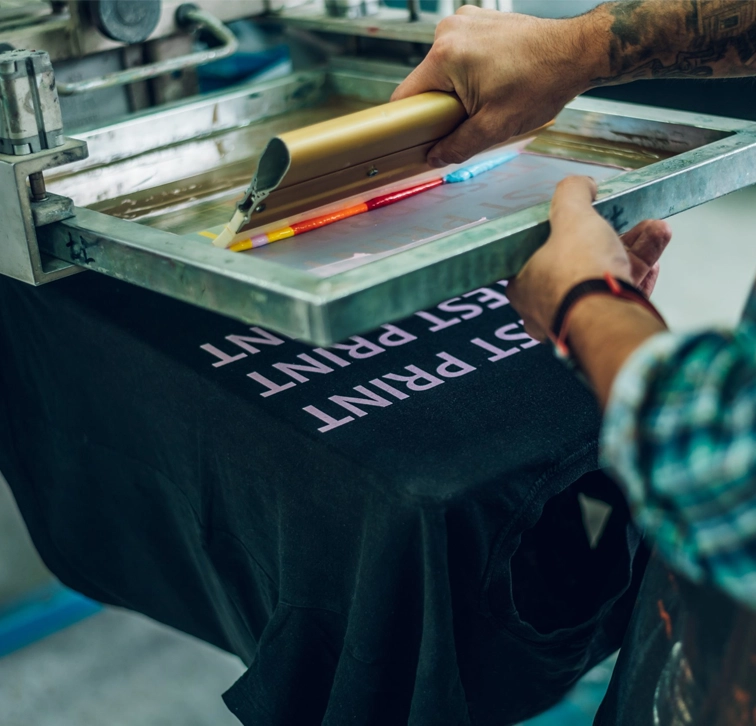
Screen printing becomes economically viable at volume. Platforms may offer screen printing for orders exceeding a certain quantity. The process yields vibrant, durable prints and is well-suited to bold, limited-color designs. The customizer must weigh the per-unit cost savings against the higher minimum order quantity.
Embroidery and Heat Transfer: Premium and Specialty Options
Embroidery is available on many platforms for an additional charge and often with a higher minimum. It confers a premium, tactile quality suited to logos and text. Heat transfer vinyl is another option, offering a range of finishes—matte, gloss, metallic, flocked—and suitability for small, detailed designs.
Proofing and Quality Assurance in the Digital Workflow
The Digital Mockup: Interpretation and Skepticism
Every reputable platform provides a digital mockup before production. This mockup is a simulation, not a photograph. It approximates the appearance of the finished product but may not capture the subtleties of fabric texture, ink opacity, or embroidery sheen. The customizer should interpret the mockup with a degree of skepticism and request a physical sample when possible.
Physical Samples: The Case for Tangible Verification
For orders of significant value or complexity, a physical sample is indispensable. The sample reveals the true color, the hand-feel of the fabric, the accuracy of the print or embroidery, and the overall quality of construction. The cost of a sample is trivial compared to the cost of a flawed bulk order.
Logistical Considerations: Minimums, Timelines, and Shipping
The Minimum Order Quantity Spectrum
Minimum order quantities vary widely across platforms. Print-on-demand aggregators have no minimum. Traditional decorators may require six, twelve, or twenty-four pieces. The customizer must align the platform’s MOQ with the intended scale of production.
Production Calendars in a Just-in-Time Era
Production timelines range from a few days to several weeks. Rush options are often available at a premium. The customizer should factor in shipping time when calculating the total lead time. For event-driven orders, a buffer of several days is prudent.
Shipping, Duties, and the Geography of Fulfillment
The geographic origin of the platform’s production facilities determines shipping costs and transit times. Domestic platforms offer faster, cheaper shipping. International platforms may offer lower unit costs but impose duties, customs delays, and higher shipping fees. The total landed cost is the relevant metric.
The Economic Calculus: Pricing Structures and Hidden Costs
Unit Pricing and Volume Tiers
Unit pricing is typically tiered by volume. The per-unit cost declines as the order quantity increases. The customizer must determine the optimal quantity by balancing the desire for low unit cost against the risk of unsold inventory.
Setup Fees, Art Charges, and Ancillary Costs
Beyond the unit price, ancillary costs may accrue. Setup fees apply to screen printing and embroidery. Art charges apply when the platform’s designers must refine or recreate the uploaded artwork. Shipping, taxes, and rush fees are additional. A comprehensive cost analysis should include all these elements.
Conclusion: The Virtual Hoodie as a Nexus of Convenience and Craft
The online customization of hoodies is a phenomenon of the digital age. It offers convenience, accessibility, and a degree of creative control that was unimaginable to previous generations. Yet it also imposes constraints—the absence of tactile inspection, the mediation of the screen, the standardization of production. The successful online customizer is one who understands these constraints and navigates them with discernment. The virtual atelier is a powerful instrument, but it is not a substitute for the judgment of the human hand.