Selecting the right fabric construction method is one of the most critical decisions in apparel manufacturing. The way fibers or yarns are joined directly dictates a garment’s drape, elasticity, durability, and production cost. This guide breaks down the four core structural techniques—crocheted, knitted, nonwoven, and woven—to help you choose the ideal construction for your clothing line.
Crocheted
Crocheted fabrics are created by looping yarns together using a single hook. While traditionally a handcraft, commercial crocheting utilizes specialized machinery to mimic this distinct, open-work aesthetic.
- Characteristics: Highly textured, open-work structures, distinctive patterns, and medium-to-high elasticity depending on the yarn used.
- Best Used For: Festival wear, summer swimwear cover-ups, bohemian apparel, textured cardigans, and decorative trims.
- Brand Strategy: Choose crochet if your collection relies on artisanal appeal, heavy visual texture, or a retro/boho identity. Because machine crochet can be slower to produce, it often carries a higher price point suited for mid-to-premium market positioning.
Knitted
Knitting forms fabric through continuous, interlocking loops of yarn (either warp or weft knitting). This construction naturally creates built-in stretch without requiring synthetic elastic fibers like elastane.
- Characteristics: Excellent elasticity and recovery, soft drape, high breathability, and wrinkle resistance. Common types include single jersey, rib knit, interlock, and French terry.
- Best Used For: Activewear, loungewear, t-shirts, underwear, sweaters, and athleisure.
- Brand Strategy: Knits are essential for any line prioritizing comfort, mobility, and relaxed silhouettes. They are cost-effective for mass production and offer versatile options ranging from lightweight tees to heavy winter outerwear.
Nonwoven
Nonwoven fabrics skip the yarn stage entirely. Instead, staple fibers or continuous filaments are bonded together mechanically, thermally, or chemically into a continuous sheet or web.
- Characteristics: Uniform structure, high dimensional stability, no unraveling or fraying, and generally low elasticity.
- Best Used For: Garment interlinings (collars, cuffs, facings), protective outerwear, disposable apparel, structural padding, and insulation linings.
- Brand Strategy: Nonwovens rarely form the exterior face of high-end fashion, but they are indispensable hidden components that provide structure and shape to tailored garments like suits and jackets.
Woven
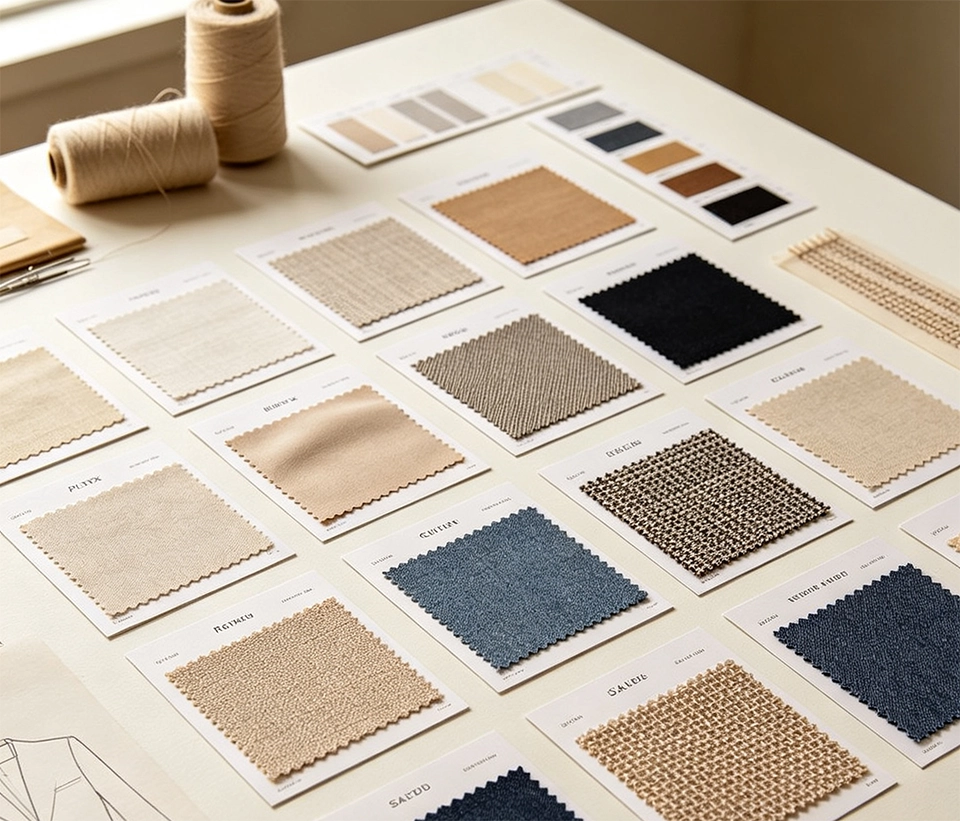
Woven fabrics are constructed on a loom by interlacing two perpendicular sets of yarns: the warp (longitudinal) and the weft (transverse). The three foundational weaves are plain, twill, and satin.
- Characteristics: Exceptional structural integrity, crisp drape, minimal natural stretch, high durability, and clean edge finishing capabilities.
- Best Used For: Tailored suits, dress shirts, denim, structured dresses, trousers, and heavy outerwear.
- Brand Strategy: Choose woven fabrics when your clothing line demands sharp tailoring, formal elegance, or durable utility. Wovens hold complex shapes and prints exceptionally well, making them the standard choice for classic apparel collections.